
Jesolo hasn’t always been the city we know today. For decades it was, above all, a seaside destination like many others — until an administrative choice changed the course of its development, bringing in some of the world’s most important international architects to design entire stretches of its coastline. The result is an urban fabric where very different visions coexist, united by one common thread: the idea that architecture can be a driver of transformation, not just decoration. Let’s retrace this story, from the first interventions of the 1990s to the most recent projects.
A city that chose architecture as its identity
The turning point came in the second half of the 1990s, when the municipal administration launched an ambitious urban renewal program known as the Master Plan, entrusted to Kenzō Tange, one of the most influential Japanese architects of the second half of the twentieth century. It was an unusual move for an Italian seaside town: handing over its urban reorganization to a world-renowned designer, with the stated goal of rethinking the balance between the built environment and quality of life.
From that moment on, many areas once used for agriculture were converted to residential use, and the coastline began to see a progressive verticalization of its buildings, with towers signed by some of the best-known names on the international scene. It’s no coincidence that several streets in the district today bear the names of the great masters of architecture — from Piazza Le Corbusier to Via Carlo Scarpa to Via Aldo Rossi — a kind of street naming that, almost in watermark, tells the story of the ambition with which Jesolo chose to reinvent itself.
The starchitects who signed the coastline
Over the following two decades, several international firms left their mark on Jesolo. The Catalan architect Carlos Ferrater designed Torre Aquileia, a project conceived less for its verticality than for its ability to stitch public space back together, linking Piazza Internazionale, Piazza Mazzini and the beach into a single route. The Portuguese duo Gonçalo Byrne and João Ferreira Nunes designed Merville, also known as Casa nel Parco: a 24-storey glass tower accompanied by six villas, set within the Jesolo Lido pine forest, with a clear focus on green building and energy efficiency.
It was during this same period that Richard Meier also arrived in Jesolo — the American architect known worldwide for his design language built on white volumes, light and transparency. His first two projects in the city both grew out of a direct collaboration with RIV: The Beach Houses and Jesolo Lido Village, the latter a residential and tourist complex combining low-rise homes set in greenery with three towers facing the sea, for a total of 240 residential units. These were the projects that first introduced Meier’s stylistic signature to the Adriatic coastline, laying the foundation for a relationship between the architect and RIV that would continue over time.
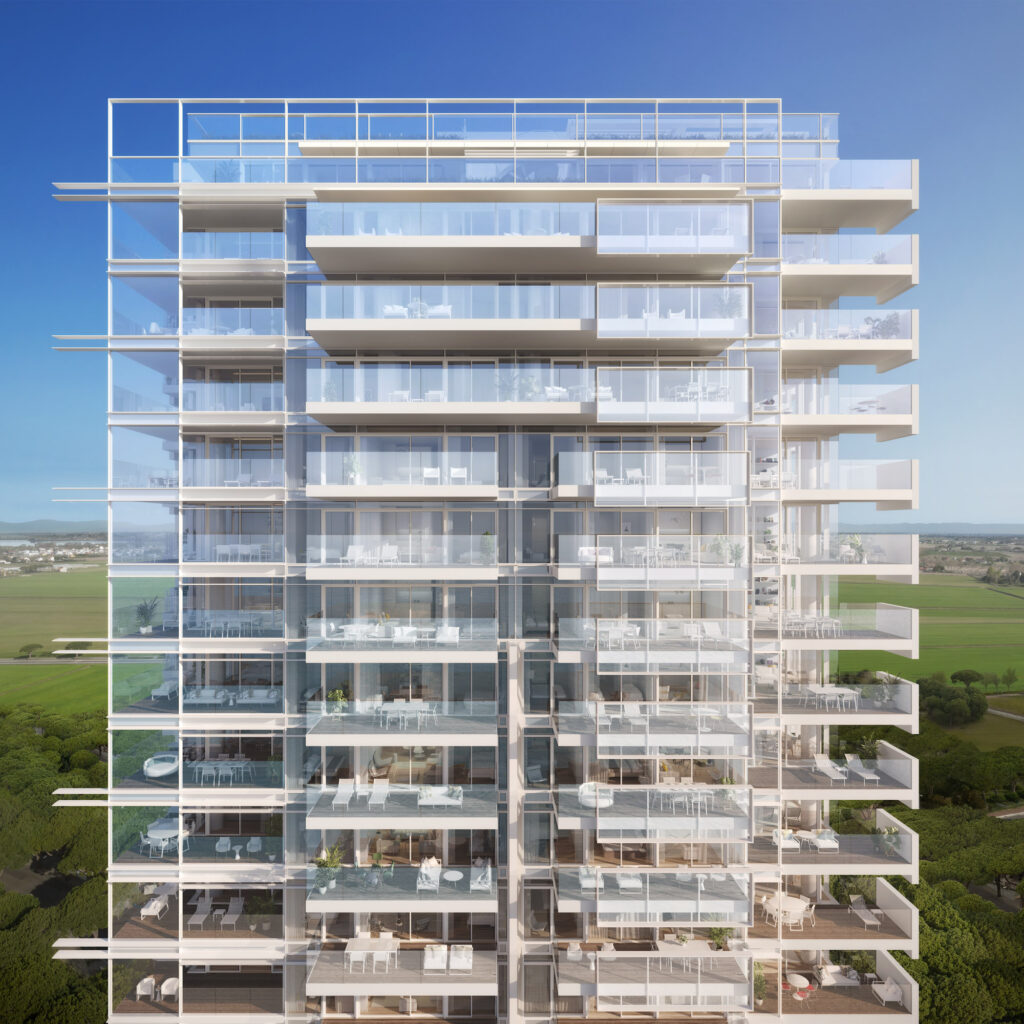
Richard Meier returns to design for RIV — this time, vertically
That relationship now finds a new chapter with The Richard Meier Tower, developed by RIV at the heart of the Jesolo Lido Design District. While the architect’s first two projects for RIV unfolded horizontally, among low-rise homes and gardens, this time the vision rises: 25 floors that redefine the city’s skyline, with the same language of glass surfaces and continuity between interior and exterior that has made Meier one of the most recognizable contemporary architects in the world.
It’s a telling way to read just how far the collaboration between RIV and the architect has matured over time — from two early projects tied to seaside tourism, to a residential project of an entirely different scale and ambition, capable of reshaping the city’s profile.
Jacopo Mascheroni and the new generation
Alongside the great names that have shaped Jesolo’s recent history, the city is now also looking to a new generation of designers. One of them is Jacopo Mascheroni, an architect known for an essential, rigorous aesthetic, whose work grows out of a dialogue between light and material in a precise synthesis of form and function. His cosmopolitan, internationally minded vision comes through in a technical execution refined down to the smallest detail.
Among Mascheroni’s works is Beach Boiserie, a project that anticipated the same compositional rigor now found in his most recent work.
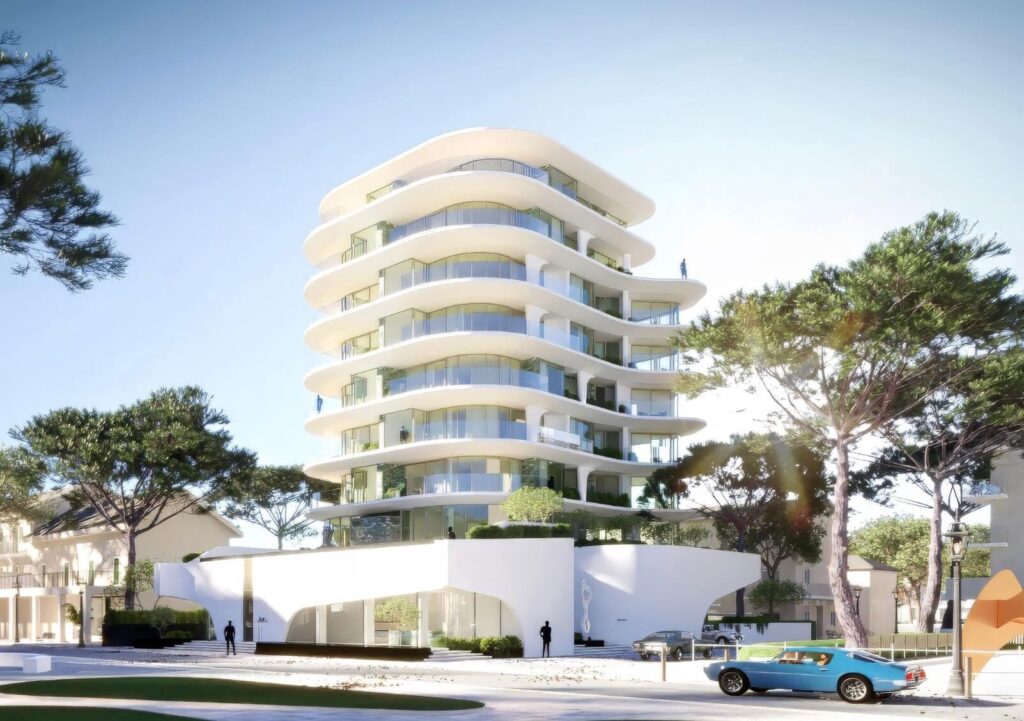
He is also the architect behind Étoile, the upcoming residential project in Piazza Brescia, in the heart of Jesolo. A development that interprets living without compromise: eighteen units spread from the third to the ninth floor, centered around a wellness level on the second floor featuring a fitness area, infinity pool and spa. Rounding out the experience is a year-round concierge service and private parking reserved for residents.
Étoile carries forward that same dialogue between international vision and local identity that has made Jesolo a case study in Italian coastal design, confirming how the city continues to attract new architectural languages without losing its overall coherence.
A coastline that keeps growing
What makes Jesolo a rare case among Italian seaside towns isn’t a single building, however iconic, but the continuity of this ambition over time: from Kenzo Tange to Ferrater, from Byrne and Ferreira Nunes to Richard Meier, up to the most recent projects signed by Meier himself and by Jacopo Mascheroni. A three-decade journey that has progressively transformed the face of the city, built in part on long-standing collaborations between developers like RIV and the architects themselves, and one that continues today at the heart of the Jesolo Lido Design District.
If you’d like to take a closer look at the most recent projects in this story — The Richard Meier Tower, The Sky Villas and Étoile — get in touch for a personalized real estate consultation.